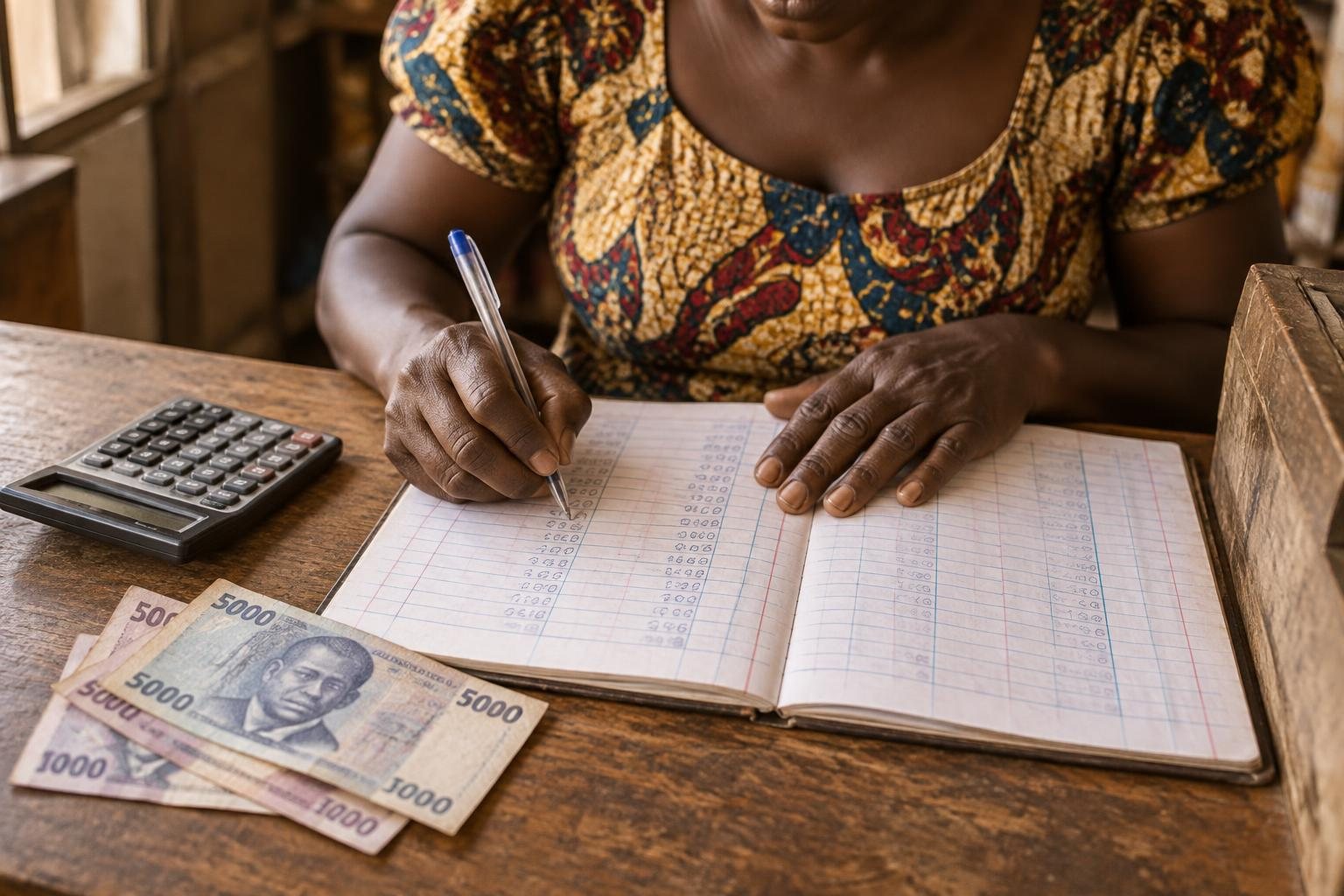
In Kinshasa, Lubumbashi or Kolwezi, an entrepreneur’s day often closes with a dilemma. Cash or Mobile Money balances are there, customers were served, yet one question remains: how much was actually earned?
The most common trap is the advance deposit. When a client pays 10,000 CDF upfront, that money is physically there. Yet it is not disposable profit: part of it will fund tomorrow’s supplies, and the balance is only earned once the work is delivered. Confusing cash on hand with earned revenue leaves small businesses vulnerable.
We built KOBETA’s public demonstration to remove this blind spot. It requires no sign-up and no password, and lets anyone test the cash logic across three reference activities.
Three business models, three realities
To make the figures tangible, the demo walks through three everyday urban cases.
1. Services: hair braiding in Bandal
A customer orders braids for 40,000 CDF and pays a 10,000 CDF deposit. The stylist incurs 9,000 CDF in direct costs: 5,000 CDF transport and 4,000 CDF hair extensions.
- Revenue is 40,000 CDF, recorded once.
- Cash collected today is 10,000 CDF.
- Accounts receivable stand at 30,000 CDF.
- Contribution margin is 31,000 CDF, before fixed overhead and payment for your work.
Collecting the balance later does not create a new sale: it settles the 30,000 CDF receivable and brings total cash collected to 40,000 CDF.
2. Retail: wax fabric at Marché de la Liberté
Ten fabric pieces are bought at 5,000 CDF each, 50,000 CDF in total. Three are sold at 8,000 CDF each.
- Revenue is 24,000 CDF.
- Cost of goods sold is 15,000 CDF.
- Gross margin is 9,000 CDF.
- The 7 remaining pieces are valued in stock at 35,000 CDF.
3. Production: mikate in Kolwezi
A batch of 10 bags needs 5,000 CDF of ingredients and 1,000 CDF of packaging, so 600 CDF per bag. Selling 4 bags at 1,000 CDF gives 4,000 CDF revenue, 2,400 CDF production cost and 1,600 CDF gross margin, with 6 bags (3,600 CDF) in stock.
Why voice changes adoption
Standard accounting tools often fail on the ground because manual entry does not fit the pace of a workshop or a shop counter.
With KOBETA, the entrepreneur records a ten-second voice note between two customers: "Braids for 40,000 CDF, 10,000 CDF deposit received, 9,000 CDF transport and extensions." The AI invents nothing: it only extracts the facts. KOBETA’s calculation engine then applies the cash rules, with no guesswork.
Building a track record for microcredit
Every recorded, confirmed or voided transaction, with its reason, feeds a tamper-proof history. Congolese francs, US dollars and euros stay separate and are never added together.
After three months, the entrepreneur no longer brings memories or a crossed-out notebook to her microfinance officer: she brings a verifiable record of collections, receivables and margins.